I help technology organizations turn strategy into execution. Working alongside CTOs, CPOs, and executive leadership teams, I enjoy bringing structure to complexity, helping leaders see around corners, and building the operating models, decision frameworks, and leadership rhythms that allow organizations to execute with greater clarity, alignment, and confidence.
Most organizations I work with have real talent and real ideas. What's missing is the system that turns them into coordinated outcomes.
Lots of great ideas, but lacking cohesion?
Lots of data, but not enough insight?
Lots of voices, but no clear decision framework?
For more than 20 years I've helped product and technology organizations turn ambition into execution — building the operating models, program management, and portfolio governance that let complex teams move as one. I started out as a software developer and DBA, and I've never lost the practitioner's instinct for how the work really gets done.
I've built PMOs from the ground up, steered large R&D portfolios through hard trade-offs, carried organizations through acquisitions and leadership change, and helped scale AI from strategy decks into production. What I enjoy most is the puzzle underneath all of it — bringing structure to complexity, and helping leaders see around corners before the corner arrives.
Today I run Dougan Consulting from Michigan, taking on a small number of advisory engagements at a time. I still build, too — prototyping production AI apps in Python, Streamlit, and the Claude and OpenAI APIs. I hold a B.S. in Systems & Control Engineering from Case Western Reserve University.
How I help product and technology leaders move from capability to coordinated, predictable execution.
Building the cadences, governance forums, and decision frameworks that let product and technology organizations execute at scale.
Most product and technology organizations don't lack talent — they lack the system that turns talent into coordinated outcomes. I design the planning rhythms, intake and prioritization processes, delivery standards, and accountability structures that give Product, Engineering, and executive leadership clarity on priorities, trade-offs, and outcomes.
ProofBuilt Clarivate's Product & Technology PMO from the ground up — unifying six fragmented teams across four business units, growing from 25 to 45, covering 1,000+ technologists and 60+ products.
Strategic prioritization, investment trade-off analysis, and capacity-aligned planning across complex R&D portfolios.
When the portfolio gets too big to govern by intuition, leadership needs the analysis, scenario modeling, and decision frameworks that connect strategic intent to capacity and capital. I run the diagnostic, build the modeling, and surface the trade-offs that let executive teams reset investment allocation with confidence — not just for one budget cycle, but as a durable operating capability.
ProofLed $400M+ portfolio rationalization across 200+ products post-acquisition — shifting strategic allocation from 10% to 35% and resetting product direction for years forward.
Governing AI initiatives to production at scale — and applying AI hands-on to operating model, planning, and decision support.
Most organizations are still learning the difference between AI strategy decks and AI in production. I bring both: the governance frameworks that let cross-geography teams ship AI initiatives responsibly at speed, and the hands-on practitioner's view of what AI actually means for how product and technology operations get done. The combination is rarer than it should be — and it's the difference between AI as a slide and AI as a working capability.
ProofGoverned 30+ AI initiatives to production at Clarivate (LLMs, RAG, Generative AI, customer-facing chatbots) and currently build production AI applications in Python, Streamlit, and the Claude and OpenAI APIs.
Operating continuity through M&A, leadership transitions, and major reorganizations — the work most organizations underestimate until momentum is already gone.
M&A integration, leadership turnover, and major reorganizations expose seams that work fine under stable conditions. I step in as the operating partner who holds delivery discipline, decision cadence, and team focus through the disruption — keeping execution moving while the organization works through the bigger changes. The goal isn't to prevent change; it's to make sure the change doesn't cost the momentum you've already built.
ProofPartnered with three successive CPOs through the CPA Global acquisition by Clarivate — holding operating continuity from diligence through Day 1 readiness and post-merger integration across multiple business units.
A few places where the operating system I built reset what the organization could deliver.
Across 200+ products. Shifted strategic allocation from 10% to 35%, resetting product direction for years.
Connected product-usage analytics to renewal planning — lifting renewals 83→92% and 86→94% across two $60M+ ARR products.
Across six business segments — with ~30% less rework and ~20% faster release cycles through stronger SDLC discipline.
Initiatives to production — LLMs, RAG, GenAI, chatbots — with delivery standards enabling cross-geography teams to execute at speed.
Unified six fragmented teams into one function — scaling 25→45 across 1,000+ technologists and a $120M+ R&D portfolio.
Integration Hub across ~15 products. Common data model + API architecture. Build-once, deploy-across — less duplication, less complexity.
Map where ideas, data, and decisions break down — the friction between strategy and what actually ships.
Build the cadences, governance forums, and decision frameworks that make the right call the default call.
Stand up the analytics and rituals, prove them in motion, then leave a system the team runs without me.
A working operating model needs working tools. These are things I'm prototyping and shipping hands-on, with Python, Streamlit, and the Claude and OpenAI APIs.
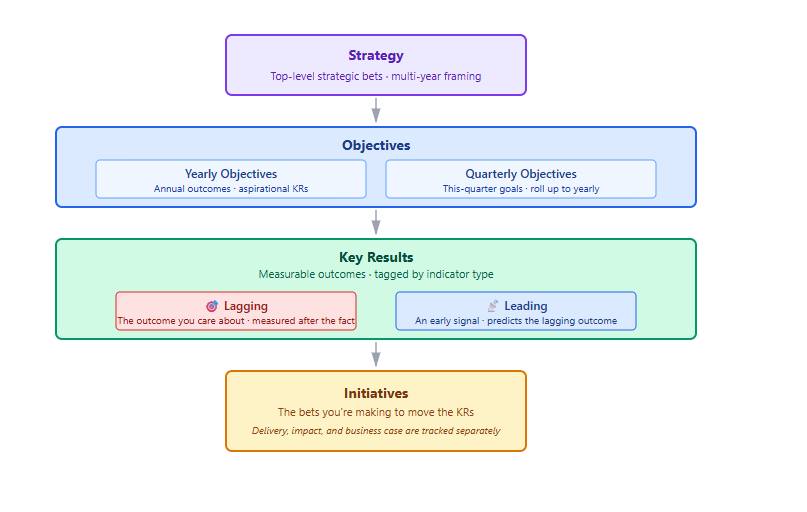
An honest take on OKR tooling. It separates delivery from impact, exec view from team view, and leading from lagging indicators. Built with Claude Code over a few weeks.
Poke around and edit anything — it's a live sandbox.
If your organization has the talent and the ideas but execution still feels unpredictable, that's the gap I close. Tell me a bit about what you're working on — I read every message.